Mapping the service behind library material requests
CHALLENGE
DocDel was the system behind several essential library services, including material requests, interlibrary loans, and course reserves.
Although librarians valued the service, years of growth had made its workflows increasingly complex. Staff had developed workarounds to manage limitations in the system, but the broader team lacked a shared understanding of how requests moved from submission to fulfillment.
Before recommending improvements, we needed to map the service, identify where friction occurred, and understand how the experience differed for patrons and staff.
PROJECT TIMELINE
Research began in October 2019.
MY ROLE
I led the research and translated a complex service into clear workflows for product, design, development, library leadership, and senior librarians.
My work included stakeholder interviews, operational data analysis, workflow mapping, and identifying opportunities for improvement.
RESEARCH METHODS
Stakeholder interviews, operational data analysis, and workflow mapping
BACKGROUND
Teachers College Library used a patron-driven acquisition model. When someone requested a book or article the library did not own, the library could purchase it or borrow it from another institution.
DocDel supported this process along with interlibrary loans and course reserves. Built internally in 2005, it brought several material-access services into one system.
The service was highly capable, but its complexity was difficult to see from the outside. Staff knowledge and informal workarounds had become essential to keeping requests moving.
RESEARCH QUESTIONS
-
Who interacted with DocDel?
-
What types of requests moved through the system?
-
How did staff fulfill each type of request?
-
Where did librarians encounter delays, confusion, or extra work?
-
Where did patrons experience friction?
-
Which parts of the service offered the strongest opportunities for improvement?
APPROACH
Understanding usage patterns
I analyzed traffic and server-log data to understand the volume and types of requests moving through DocDel.
This included:
-
Average daily requests and fulfillments
-
Request volume over time
-
Requests by academic department
-
Types of materials requested
-
Differences between faculty and non-faculty requestors
This gave the team a clearer picture of the scale of the service and the workflows used most often.
Learning the fulfillment process
I conducted in-depth interviews and working sessions with the librarian responsible for materials and acquisitions.
Together, we walked through the three primary request workflows: books, articles, and book chapters. I reviewed training materials, asked clarifying questions, and documented the decisions, exceptions, and handoffs involved in each process.
These conversations revealed where the system worked well and where staff depended on manual steps or workarounds to complete requests.
Mapping the service
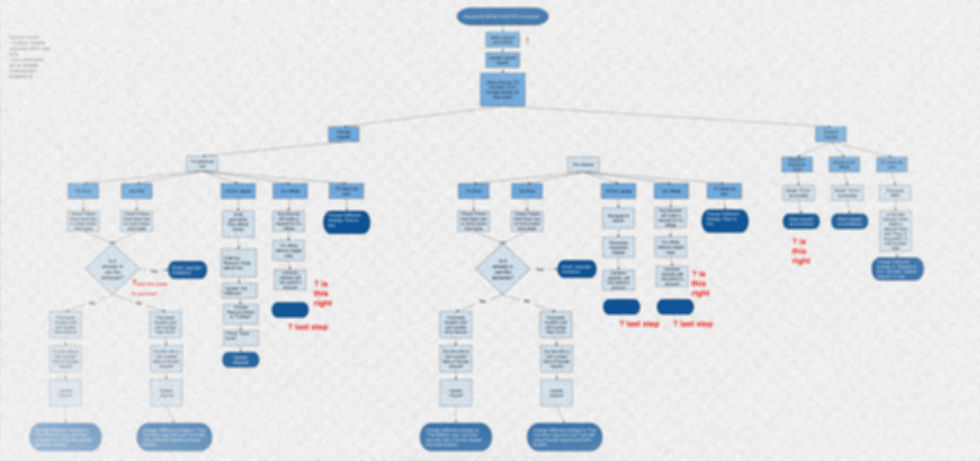
I created a series of flowcharts showing how each major request type moved from submission through fulfillment.
The maps captured:
-
Patron actions
-
Staff decisions and handoffs
-
System steps
-
Exceptions and alternate paths
-
Friction points and workarounds
The lead librarian reviewed the flows to confirm their accuracy.
OUTCOME
The workflow maps gave the broader team its first shared view of how DocDel operated across its major request types.
They made the service’s complexity visible, documented staff knowledge that had previously been difficult to access, and highlighted where the system created unnecessary effort or confusion.
The work established a foundation for discussing future improvements to the patron experience, staff workflows, and the system supporting both.
Book chapter fulfillment process

Book fulfillment process

Describe your image
Book chapter fulfillment process
Flowcharts showing the request and fulfillment workflows. Details have been obscured to protect internal processes.