Opening up a university's digital archives
CHALLENGE
PocketKnowledge is Teachers College’s digital archive and institutional repository. It contains thousands of primary sources, including photographs, dissertations, articles, and historical correspondence.
Although the collection was valuable, the website was difficult to navigate and did not make the archive’s breadth or purpose clear. The team also wanted to better understand why members of the Teachers College community contributed their work, what prevented them from doing so, and how people used the archive once they arrived.
PROJECT TIMELINE
June to November 2018
MY ROLE
I led the research from discovery through evaluation. I conducted stakeholder interviews, literature reviews, analytics and server-log analysis, market research, participatory design, and benchmark usability testing. I synthesized findings and shared recommendations with product, design, development, and library leadership.
RESEARCH METHODS
Stakeholder interviews, literature reviews, participatory design, analytics and server-log analysis, market research, and benchmark usability testing
BACKGROUND
PocketKnowledge served two purposes: preserving materials related to Teachers College history and providing a place for faculty, staff, and students to contribute their own scholarly work.
Most of the archive’s growth came from materials uploaded by library staff rather than individual contributors. The redesign therefore needed to improve both discovery and contribution, while helping people understand what the archive was for and why participating mattered.
RESEARCH QUESTIONS
-
How did people use PocketKnowledge?
-
Which materials, pages, and search terms were most popular?
-
What made people more or less likely to contribute their work?
-
What were the most common usability and navigation problems?
-
Who were the archive’s most active contributors and readers?
-
How could the redesigned experience better support both discovery and participation?
APPROACH
1. Aligning around the future of the archive
I began with stakeholder interviews to understand the original vision for PocketKnowledge, recurring pain points, known use cases, and concerns about the redesign.
I also led a participatory design workshop with library staff. Through small-group activities, participants explored patron needs, brainstormed future features, and created concepts for a next-generation archive experience.
The workshop helped build shared ownership of the project and surfaced ideas that informed the redesign.
2. Building domain knowledge
I conducted literature reviews in three areas:
-
The history and original design decisions behind PocketKnowledge
-
How academics viewed and used institutional repositories
-
Metadata practices that affected contribution and discovery
I condensed the research into short summaries for the team and translated key findings into design and content implications.
This work also informed a plain-language guide explaining the benefits of contributing work to the archive.
3. Understanding current behavior
I analyzed web traffic and server logs to understand how people were using the archive.
The analysis included:
-
Frequently viewed and downloaded materials
-
Popular searches and browsing patterns
-
Active contributors and readers
-
Referral sources
-
Logged-in and logged-out behavior
-
Contribution and commenting activity
-
Traffic patterns over time
This helped the team identify high-value content, common pathways, and areas where the archive was not supporting users effectively.
4. Exploring the market
I reviewed institutional repository platforms used across higher education, including hosted and proprietary options.
I compared common patterns, notable features, and less traditional archive experiences outside academia. The findings gave the designer a broader set of references and helped the team distinguish expected functionality from opportunities to improve the experience.
5. Measuring the redesign
I conducted benchmark usability testing before and after the redesign.
Participants completed similar tasks in both versions, including searching for and navigating to specific archive materials. Using comparable scenarios allowed the team to evaluate whether the redesigned experience improved findability, navigation, and overall clarity.
OUTCOME
The redesigned archive made it easier for people to understand what PocketKnowledge contained, find materials, and navigate the collection.
The research also helped the team clarify the archive’s role as both a historical resource and a place for the Teachers College community to preserve and share its own work.
In addition to informing the website redesign, the project produced:
-
A clearer understanding of reader and contributor behavior
-
A set of prioritized design and content recommendations
-
Comparative research on institutional repository platforms
-
A plain-language resource encouraging community contributions
-
Pre- and post-redesign usability evidence to evaluate improvement

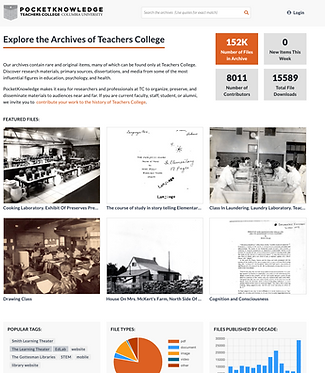
The redesigned homepage (right) introduced clearer navigation, stronger visual hierarchy, and more direct ways to explore the archive’s collections.
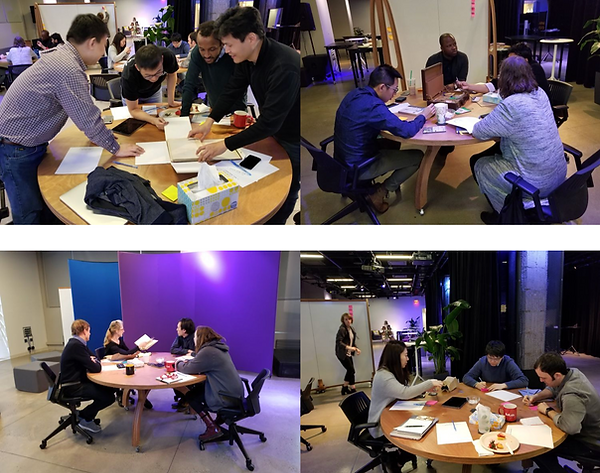
Library staff worked together to identify needs, imagine future features, and prototype ideas for a more useful and welcoming archive experience during a participatory design workshop.